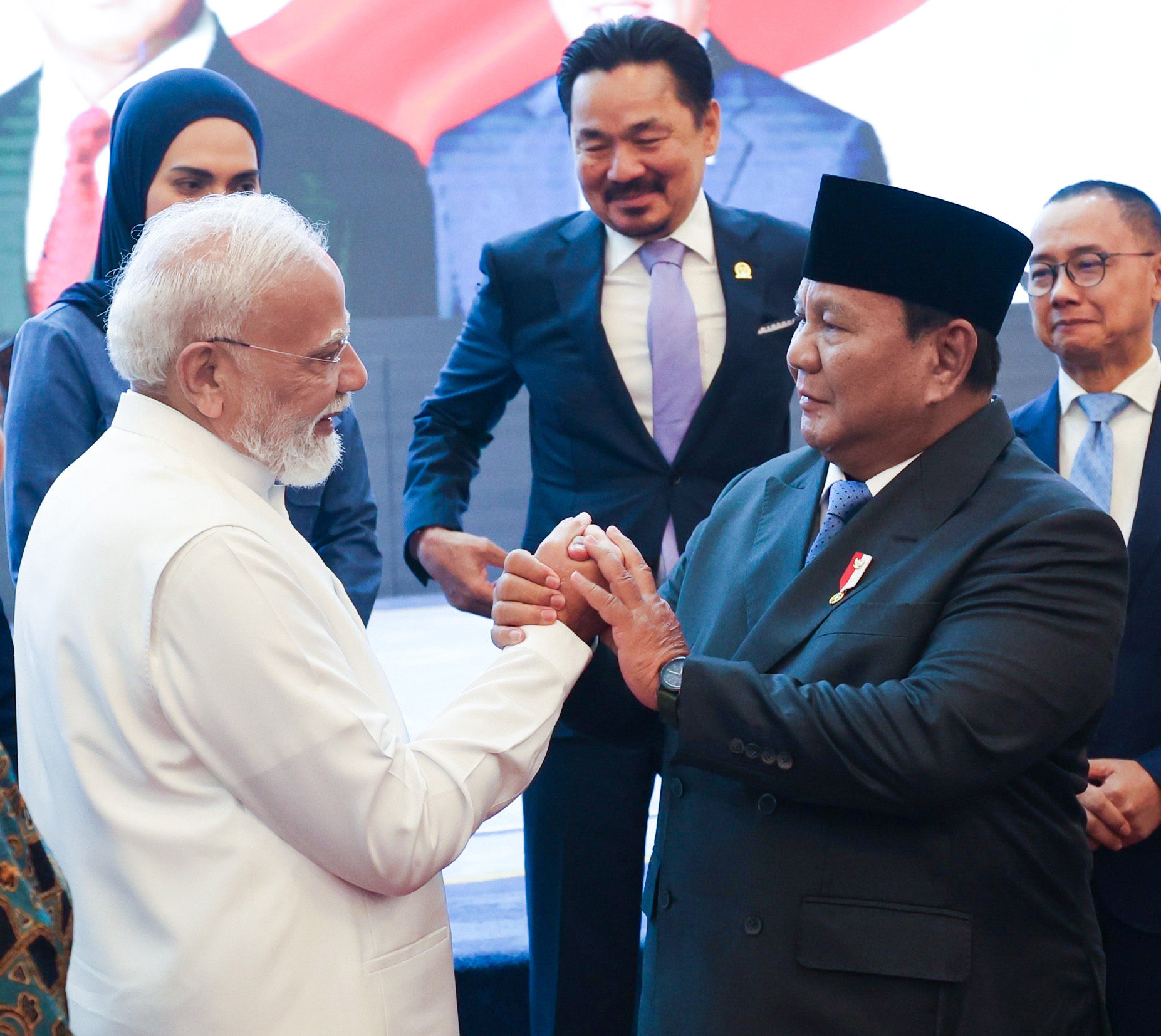
Prime Minister Narendra Modi's recent visit to Indonesia may eventually be remembered as one of the most important moments in India–Indonesia relations. Much of the international media focused on Indonesia's proposed purchase of the BrahMos missile system, the conferment of Indonesia's highest civilian honour—the Bintang Adipurna—and the fourteen agreements signed during the visit covering defence, artificial intelligence, critical minerals, maritime cooperation and higher education. All these developments are undoubtedly important. Nevertheless, taken together, they point to something much larger. They show that India and Indonesia are finally beginning to translate centuries of civilisational ties into practical cooperation.
This transformation deserves attention because it has taken a long time to arrive. India and Indonesia have shared one of the world's oldest civilisational relationships. For nearly two thousand years, merchants, monks, scholars and travellers crossed the waters of the Indian Ocean, carrying not only goods but also ideas, languages, religions and artistic traditions. The influence of this interaction can still be seen in Indonesia's temples, literature, languages and performing arts. However, despite this extraordinary historical connection, modern India and Indonesia never fully realised the strategic potential of their relationship.
Part of the answer lies in the evolution of bilateral relations over time. The first phase was shaped by anti-colonial solidarity under Jawaharlal Nehru and Sukarno, whose vision found expression in the Bandung Conference and later in the Non-Aligned Movement. The second phase began with India's Look East Policy and Indonesia's democratic transition. Defence dialogue expanded, maritime cooperation improved, and, during Prime Minister Modi's visit to Jakarta in 2018, bilateral ties were elevated to a Comprehensive Strategic Partnership (CSP). However, for several years, that partnership remained stronger on paper than in practice.
The latest visit marks the beginning of a new phase. This time, the emphasis was not on announcing new intentions but on implementing existing commitments. Defence cooperation, emerging technologies, critical minerals, education and cultural diplomacy have all begun moving together. The partnership is no longer driven solely by history; it is increasingly strengthened by practical cooperation.
Nothing illustrates this better than Prambanan.
Standing in the heart of Java, Prambanan is far more than Indonesia's largest Hindu temple complex. Built during the ninth century under the Sanjaya Dynasty, its magnificent reliefs narrate episodes from the Ramayana and Krishnayana, reminding visitors that ideas once travelled as freely across the Indian Ocean as merchants and sailors. Alongside Borobudur, Prambanan is one of the strongest symbols of Indonesia's civilisational confidence. The famous legend of Loro Jonggrang has ensured that the temple survives not only as an archaeological monument but also as a living cultural tradition and the local wisdom passed from one generation to another.
India's decision to assist in restoring the Prambanan Trimurti shrine, therefore, carries significance beyond heritage conservation as it reflects a shared responsibility for preserving a common civilisational inheritance. Prime Minister Modi's assurance that he would return to Prambanan after the restoration is completed sends an equally important message. India is no longer engaging Indonesia only through diplomacy and trade; it is investing in a relationship that recognises history as an important foundation for future cooperation.
If Prambanan symbolises the past, President Prabowo Subianto's speech offered the clearest vision of the future.
Among all the events during the visit, his address deserves far greater attention than it has received. It was much more than a ceremonial welcome. It revealed how Indonesia increasingly views India.
President Prabowo opened his address with characteristic warmth and humour. Referring to a recent DNA test, he joked that traces of Indian ancestry perhaps explained his instinctive affection for Indian music. The remark drew laughter, but it also conveyed a larger truth—that the relationship between India and Indonesia did not begin with modern diplomacy. It is the product of centuries of civilisational interaction, cultural exchange and shared historical experience.
More significant were his remarks on democracy and governance. Calling India and Indonesia two of the world's three largest democracies, he described democracy as difficult but worth protecting. He openly acknowledged that Indonesia continues to learn from India's democratic experience, particularly from the Election Commission of India. For a country as diverse as Indonesia, India's ability to conduct peaceful elections across a population of more than 1.4 billion people represents an achievement worthy of study.
The most remarkable moment came when President Prabowo admitted that he had carefully studied Prime Minister Modi's public policies and had adopted many of them in Indonesia. Smiling, he added that since there were no copyrights on those policies, nobody could sue him.
This simple remark is one of the most important outcomes of the visit.
Countries often exchange technology. They frequently sign defence agreements. However, it is much rarer for one head of government to publicly acknowledge another country's governance model as a source of inspiration. President Prabowo was not merely praising Prime Minister Modi. He was recognising India as a country whose institutions, governance practices and public policies deserve attention and adaptation. That represents a much deeper level of confidence than any single defence agreement can convey.
This growing trust also explains why cooperation is expanding into areas such as defence technology, artificial intelligence, critical minerals, maritime security and higher education. When countries trust one another, it becomes easier to cooperate in sensitive sectors. Over time, such cooperation strengthens the partnership and makes it more durable.
For this reason, Prime Minister Modi's visit should not be judged solely by the number of agreements signed. Those agreements are important, but they are only one part of the story. The larger story is that India and Indonesia appear to have entered a new phase in their relationship—one built not only on shared history but also on mutual trust, institutional learning, and a willingness to work together to shape the future.
If the fourteen agreements provide the framework for this new partnership, President Prabowo's speech gave it its vision. It publicly affirmed that Indonesia now sees India not only as a civilisational friend, but also as a trusted democratic partner, a source of policy innovation and an important strategic actor in the Indo-Pacific. That may become the most enduring legacy of Prime Minister Modi's visit.